Designing Autonomous Workflows: A Blueprint for Complex Business Logic
Z
Zycic Team
June 29, 20261 min read
As businesses scale, the bottleneck shifts from data collection to process execution. Traditional automation relies heavily on rigid, linear "if-this-then-that" rules. However, modern operations require dynamic decision-making systems capable of handling unexpected edge cases.
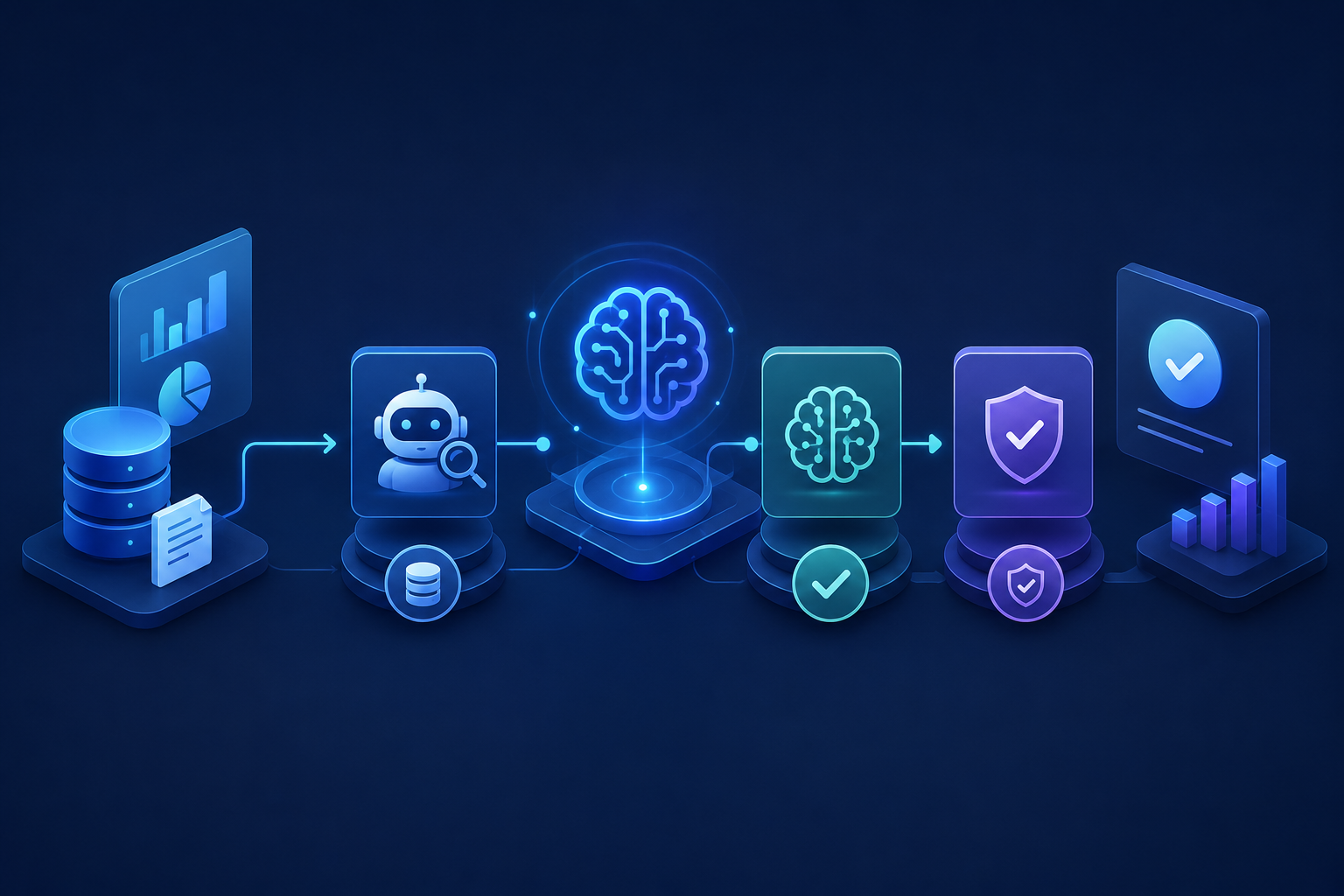
Building true autonomous workflows requires transitioning to multi-agent AI architectures. Unlike single-prompt tools, multi-agent frameworks divide complex business tasks into specialized roles (e.g., a data retrieval agent, a reasoning agent, and a validation agent). By building stateful systems using tools like LangChain or FastAPI backends, these systems execute complex processes with human-level accuracy.
The goal of autonomous workflows isn't just to replace manual keystrokes, but to eliminate operational friction entirely, allowing engineering teams to design deterministic outcomes within unpredictable business environments.
#AI / Automation
Z
Zycic Team
Zycic Expert Contributor
Dedicated to delivering high-performance web development and AI-driven solutions.